
Setup Email on Outlook (IMAP)
Find the step-by-step tutorial for your specific version of Outlook below. If you aren't sure which version you have, you can usually find this info under the Help menu or the About section within the app.
Large Mailboxes: Depending on your internet speed and the size of your mailbox (we support up to 200GB per account), the initial synchronization can take anywhere from a few hours to a few days to fully build your local data file.
Enhanced mailbox? Connect a a CardDAV address book or a a remote calendar (CalDAV) to keep your contacts and schedule in sync in Outlook.
Use the following settings or follow the Outlook 365 or Outlook 2013/2010 instructions below.
| Service | Server Address | Port (SSL/TLS) |
| Incoming (IMAP) | imap.emailarray.com | 993 |
| Outgoing (SMTP) | smtp.emailarray.com | 465 |
We recommend using using IMAP with SSL/TLS to ensure your data remains private and your folders stay synchronized across all devices.
The New Outlook for Windows
Microsoft has recently introduced a "New Outlook" for Windows. Based on our testing and official Microsoft documentation, this version handles IMAP accounts differently than previous versions.
What you need to know
- Forced Cloud Sync: Unlike "Classic" Outlook, the "New Outlook" requires all IMAP accounts to sync through the Microsoft Cloud.
- Data Privacy: This means your emails, even though hosted securely with us, will be stored on Microsoft’s servers to enable this sync.
- Setup Failures: Because Microsoft forces this intermediary sync, many IMAP setups fail during the "Syncing to Microsoft" phase, even if your credentials and server settings are 100% correct.
Our Recommendation: Use "Classic" Outlook
To maintain a direct, private connection between your device and our servers, and to avoid setup errors, we recommend staying with with Classic Outlook.
-
Open Outlook.
-
Locate the "Try the new Outlook" toggle in the upper-right corner.
-
Switch the toggle Off.
-
Restart Outlook and follow the Outlook 365 or Outlook 2013/2010 instructions below.
For a deeper dive into why Microsoft implemented this change, you can read the full discussion on the Microsoft Community page.
Outlook 365
Unfortunately, this version of Outlook doesn't support Autodiscover for IMAP accounts anymore.
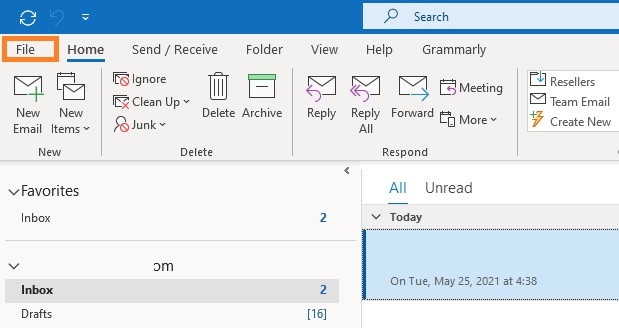
- Click on
thethe File menu - Click
onon + Add Account
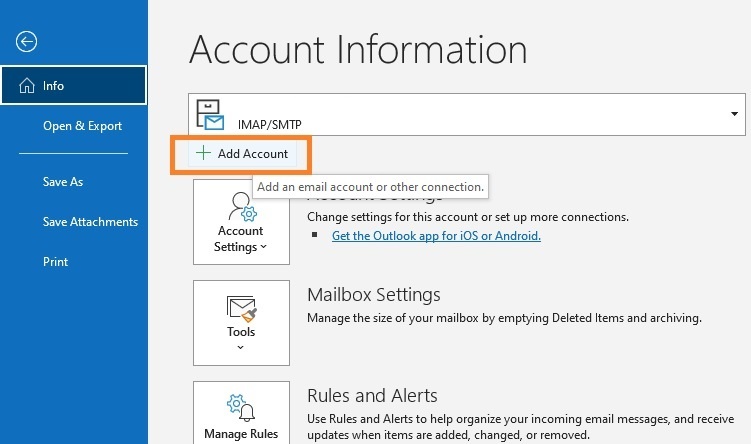
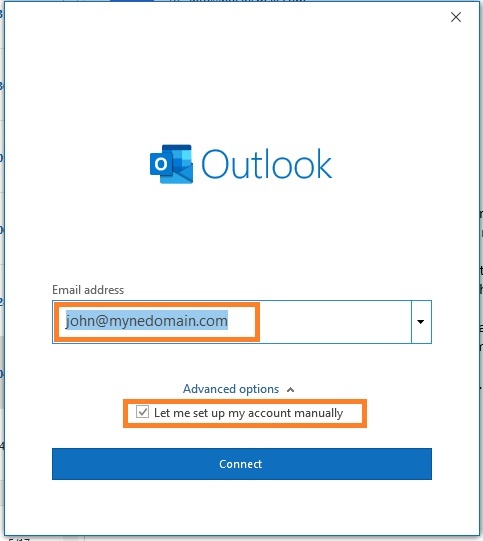
- Fill in your
fullfull email addressoptionoption Let me set up my account manually. - Click
onon Next.
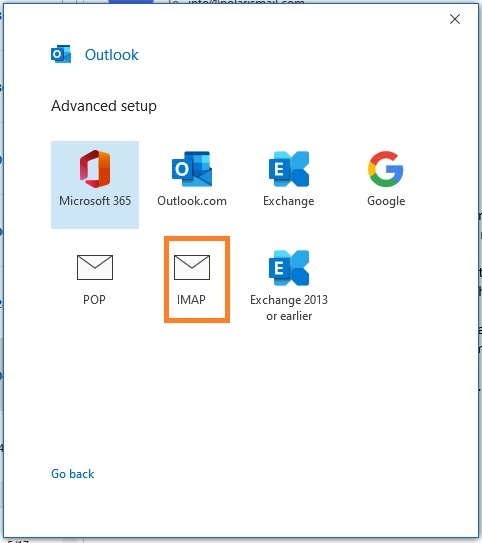
SelectSelect IMAP
- Fill in server
informationinformation fromthethe Server & Ports page - Click
onon Next
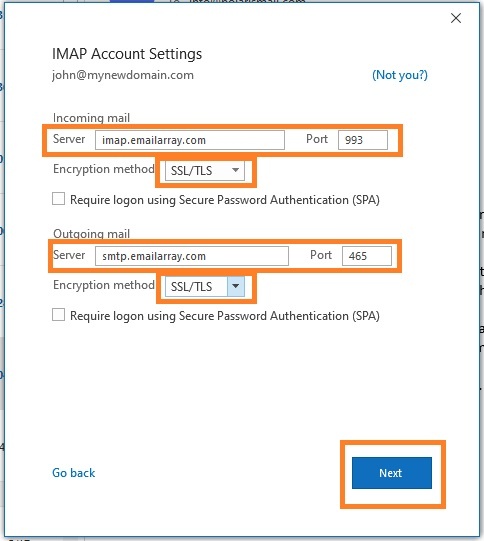
- Fill in your
existingexistingpasswordpassword for your email address and clickonon Connect
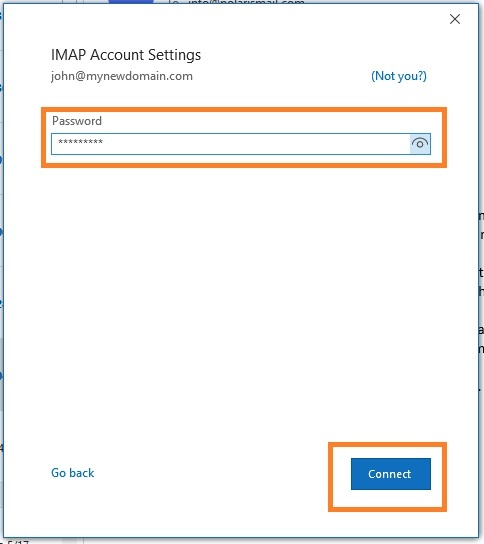
- The setup is completed. The
messagemessage Account successfully added
Depending on the size of your mailbox and your Internet speed, Outlook might take from a few hours to a few days to synchronize the mailbox and build the local PST file.
Outlook 2013/2010:
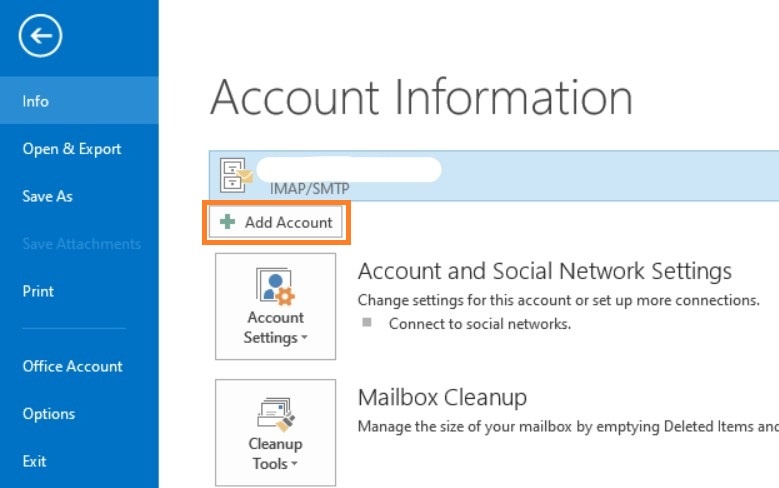
- Click on
thethe File menu - Click
onon + Add Account
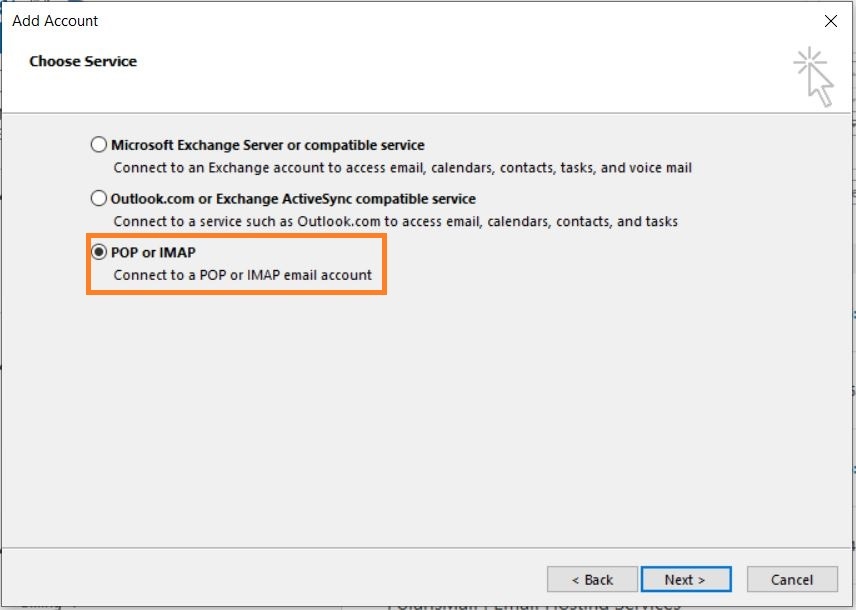
SelectSelect POP or IMAP
- Option 1: this version of Outlook supports Autodiscover for IMAP accounts if you
havehave setup Autodicover in your DNS.- Type in your full name, e-mail address, and password and click
onon Next - Click
onon Allow - Click
onon Finish
- Type in your full name, e-mail address, and password and click
- Option 2: If you don't have Autodicover
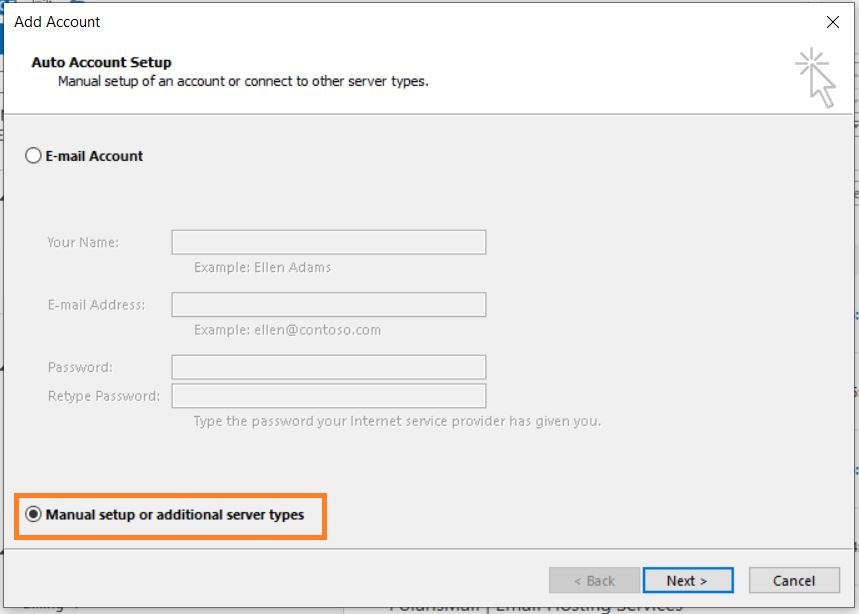
selectselect Manual setuponon Next.
-
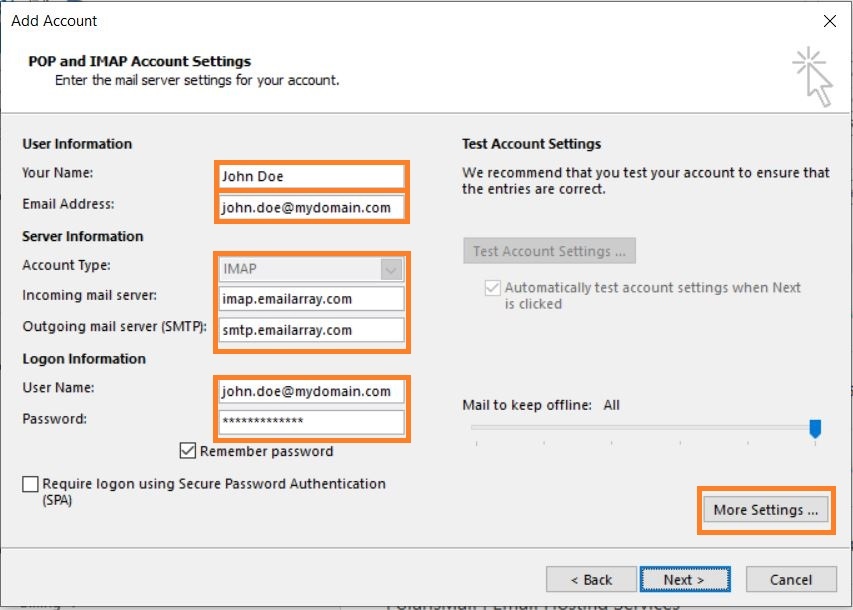
- Type in your full name, e-mail address, and password
- Fill in server
informationinformation fromthethe Server & Ports page
-
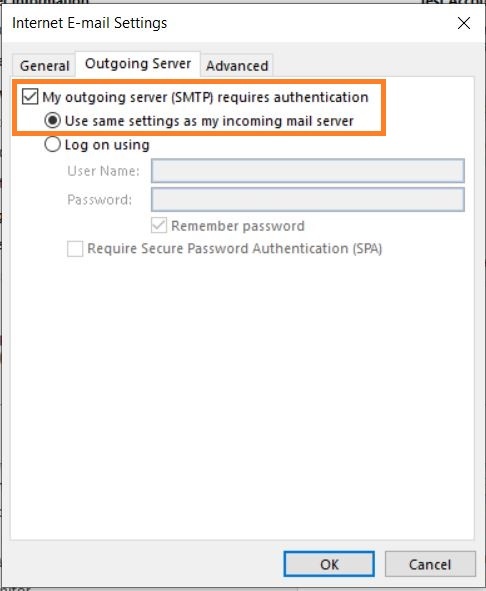
- Click
onon More Settings. SelectSelect My outgoing server (SMTP) requires authenticationandand Use same settings as my incoming mail server.
- Click
-
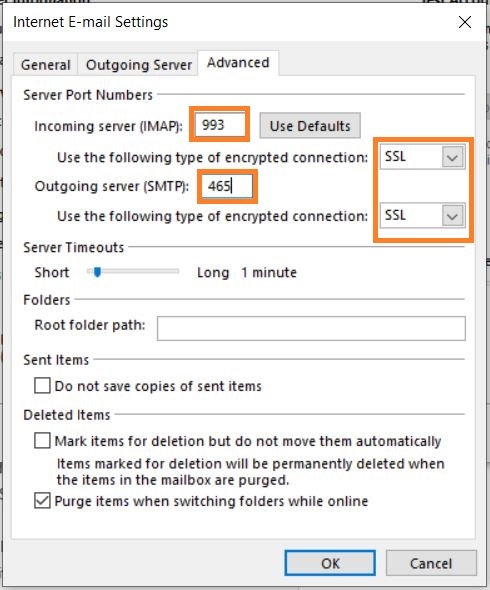
- Click on
thethe Advanced - Verify the ports are correct and SSL is selected.
- Click on
-
- Click
onon OK. Clickonon Next
- Click
Depending on the size of your mailbox and your Internet speed, Outlook might take from a few hours to a few days to synchronize the mailbox and build the local PST file.