Super Panel
- How to Change Your Super Password
- Adding New Customers: How to Create an Admin Account
- Finding and Managing Admin Accounts
- Transferring Domains Between Admin Accounts
- Super Panel Settings
- Super Panel Branding for Webmail
- Super Delegates
How to Change Your Super Password
Your Super Panel is the command center for your entire email infrastructure. To keep your account secure, we recommend updating your master password periodically and enabling additional security layers like Two-Factor Authentication (2FA).
How to Change Your Password
Updating your master access is a straightforward process that helps keep your account secure. It is recommended to update your password regularly to maintain enterprise-grade reliability.
-
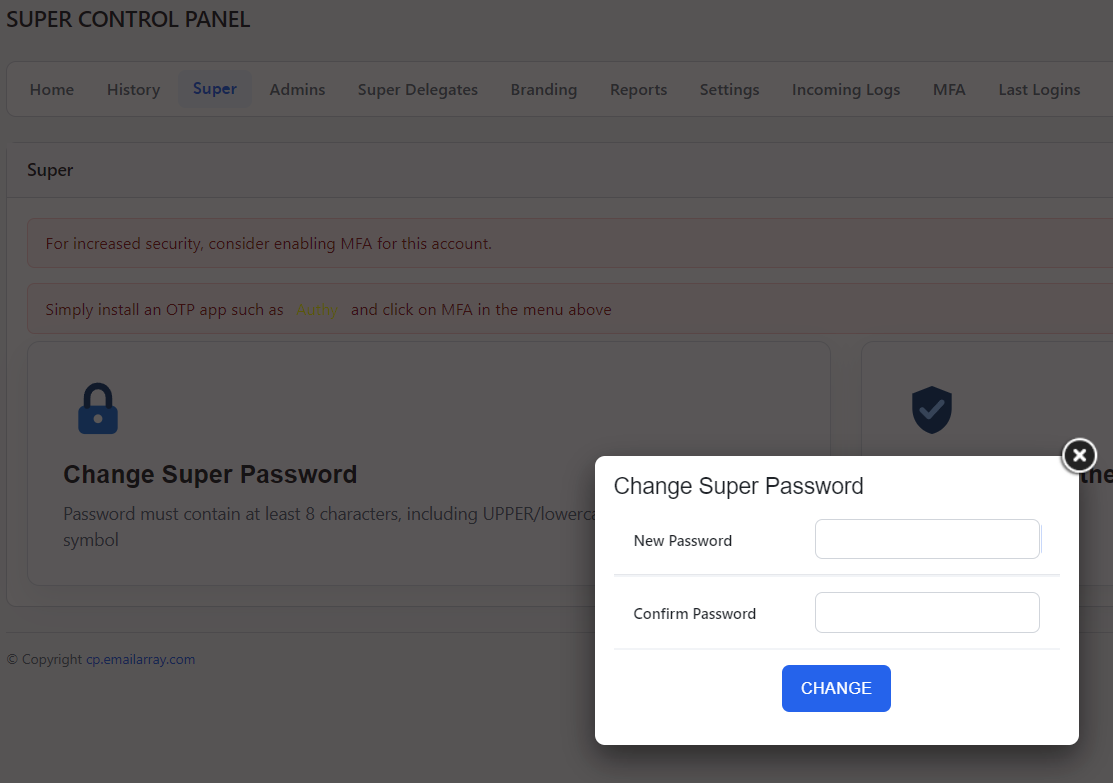
Access the Super Menu: From the Super Panel, in the main navigation menu, click on the Super tab.
-
Initiate the change: Click on the Change Super Password section.
-
Enter your new password: A pop-up window will appear. Enter your new secure password in both the New Password and Confirm Password fields.
Password requirements: To ensure your account remains protected, your new password must meet the following criteria:-
-
-
It must contain at least 8 characters.
-
It must include a mix of uppercase and lowercase letters.
-
It must include at least one number and one special symbol.
-
-
-
-
Confirm the update: Click the blue Change button to save your new settings.

How to Reset a Forgotten Password
If you have lost access to your Super Panel account, you can quickly request a reset link to regain entry. This process is managed through your recovery email address to ensure account security.
Steps to reset your password
-
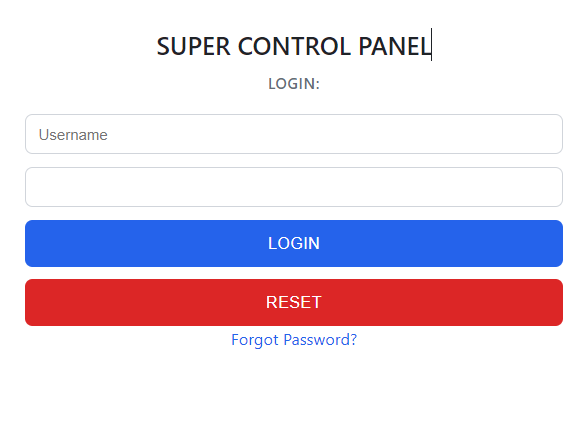
Open the login page: Navigate to your Super Panel login screen.
-
Initiate the reset: Click the Forgot Password? link located at the bottom of the login box.

-
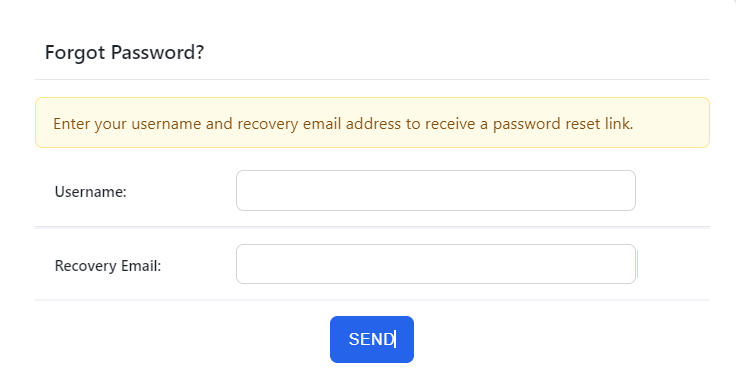
Provide your details: On the next screen, enter your Username and your registered Recovery Email address.

-
Request the link: Click the blue SEND button to receive a password reset link via email.
-
Check your inbox: Follow the instructions sent to your recovery email to choose a new secure password and log back in.
Quick Tips
-
No email? If you do not receive the reset link within a few minutes, please check your spam or junk folder.
-
Accuracy is key: The reset will only trigger if both the username and the recovery email match our records.
-
Need more help? If you cannot remember your recovery email or username, please contact our support team for assistance.
Secure Your Account with Two-Factor Authentication
A strong password is your first line of defense, but adding Two-Factor Authentication (2FA) provides a vital extra layer of security for your account.
Why use 2FA / MFA?
Even if someone manages to obtain your password, they cannot access your account without a unique, time-sensitive code generated by your mobile device. This simple step significantly reduces the risk of unauthorized access.
How to set it up
Setting up 2FA is quick and straightforward:
-
Download an authenticator app: Install a trusted app like Google Authenticator, Authy, or Microsoft Authenticator on your smartphone.
-
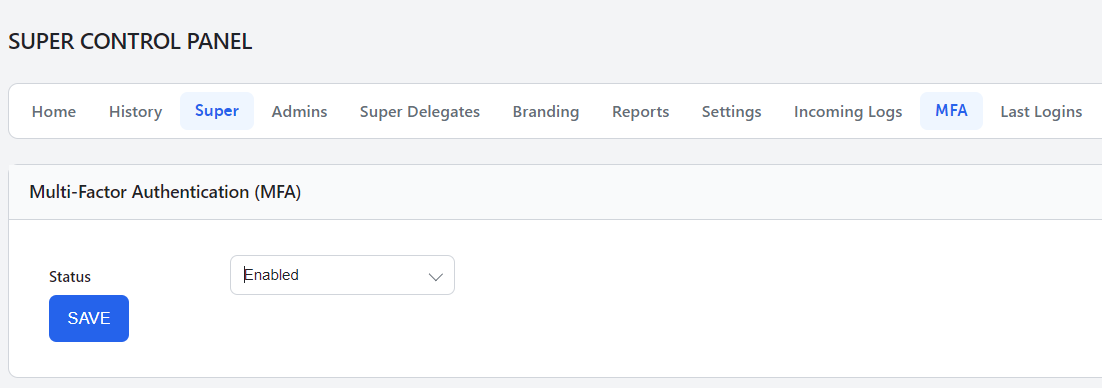
Access the MFA settings: In the top menu of your Super Panel, click on the MFA tab.
- Enable the service: In the Multi-Factor Authentication (MFA) section, change the Status to Enabled and click the Save button.

-
Scan and link: Use your authenticator app to scan the QR code that appears on your screen.
-
Verify the connection: Your app will generate a 6-digit code. Enter this into the Challenge field in the Super Panel. Click Save before the code in your app expires.
Adding New Customers: How to Create an Admin Account
Managing your growth is simple. When you bring a new customer on board, you’ll start by creating an Admin account for them in the Super Panel. This gives them (or you) the power to manage their specific domains and mailboxes.
Note: Before you begin, please check your available resources. If you need more mailboxes or storage space, you can easily increase your quota from your billing panel.
Step 1: Create the Admin Account
First, log into your Super Panel and navigate to the ADMINS tab.
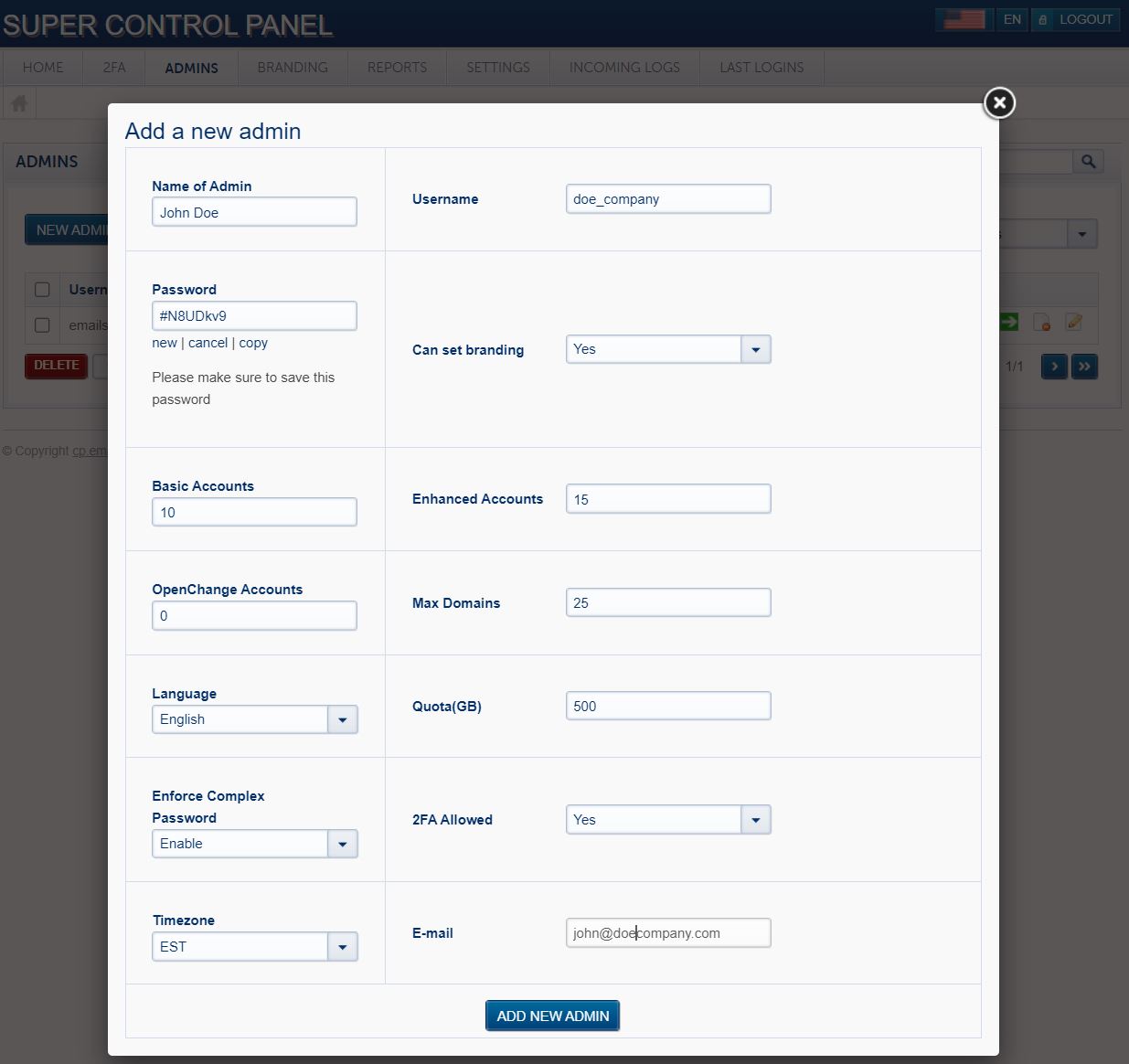
- Open the Setup Form: Click on New Admin.
- Basic Information: Enter the administrator's name, choose a unique username, and set a secure password.
- Set Resource Quotas: You must enter a value for every field (use "0" if a feature isn't needed):
- Mailbox Quotas: Define how many Basic or Enhanced they can create.
- Max Domains: Set the limit for how many domains this admin can manage. Tip: A standard rule of thumb is one domain per purchased mailbox.
- Quota (GB): Assign the total storage allowance for this customer. You have the flexibility to divide your total storage space however you like among your clients.

- Finalize: Choose the default language and timezone for the admin, then click Add New Admin.
Step 2: Choose Your Onboarding Path
Once the account is created, you have two ways to handle the mailbox setup:
Option A: The Hands-Off Approach (Customer-Led)
Provide your customer with their new Admin login credentials. They can then log in and create their own mailboxes at their convenience.
Option B: The White-Glove Approach (Reseller-Led)
If you prefer to set everything up for your client, you can do so without needing their specific password:
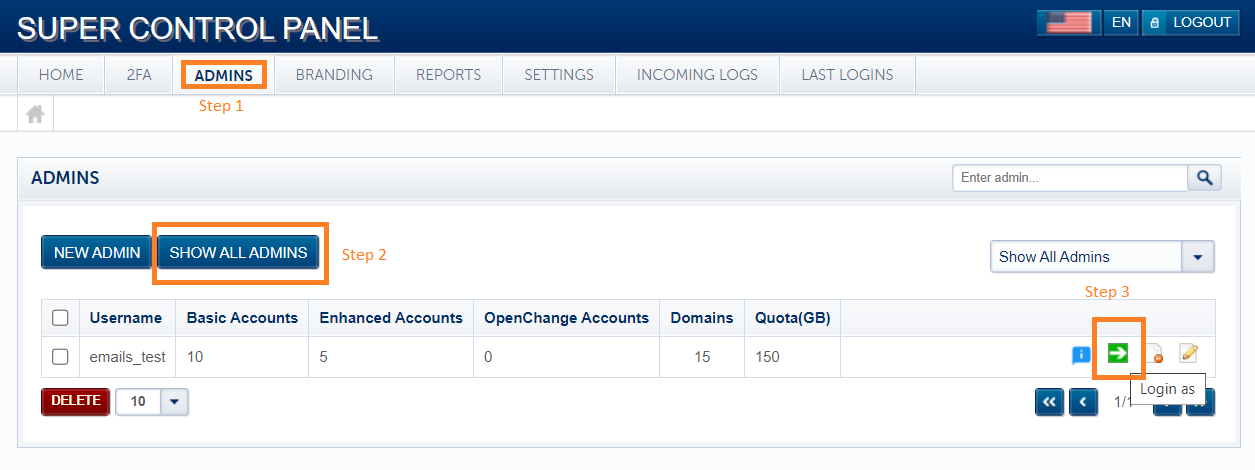
- Go to the ADMINS tab and click Show All Admins.
- Locate your customer in the list.
- Click the "Login as" icon (the green arrow) to instantly access their dashboard and create mailboxes on their behalf.

Need help creating the actual mailboxes? We’ve made it super simple. Follow our Step-by-Step Mailbox Creation Guide to get your customer's team up and running in minutes.
Finding and Managing Admin Accounts
As you scale, you may need to quickly locate which Admin account manages a specific mailbox or domain. The Reports section in your Super Panel allows you to find these accounts in seconds and take immediate action.
Step 1: Locating the Account
To find the necessary account, log into your Super Panel and click on the REPORTS tab.
-
Use Filtering Options: In the "Filtering Options" section, you can search for an account using several criteria:
-
Username or Domain: Best for finding which Admin owns a specific email address or website.
-
Last Login: Useful for identifying inactive accounts.
-
Account Type or Quota: To find users based on their service level or storage usage.
-
-
Run the Search: Enter your criteria (e.g., set the filter to "Domain" and type in the customer's domain) and click SEARCH.
Step 2: Taking Action
Once you’ve located the correct Admin in the search results, you have three primary tools at your disposal:
1. Login as Admin (Green Arrow)
Click the green arrow icon to instantly "log in as" that administrator. This allows you to manage their mailboxes, aliases, and settings directly without needing their password.
2. Edit Account Details (Pencil Icon)
Click the pencil icon to open the Admin’s settings. From here, you can:
-
Adjust Quotas: Increase or decrease the number of allowed mailboxes or total storage space (GB) as your customer’s needs change.
-
Update Info: Change contact details or timezones.
3. Enable or Disable an Account
Within the edit pop-up, you can toggle the account status between Enable and Disable.
-
When to Disable: This is a powerful tool for billing management. If a customer hasn't paid, disabling their account blocks all logins for both the Admin and their end-users.
-
The Benefit: While logins are blocked, the accounts will still receive emails. This keeps the data intact and ensures no mail is lost while you resolve payment issues—a much safer alternative to deleting the account.
Transferring Domains Between Admin Accounts
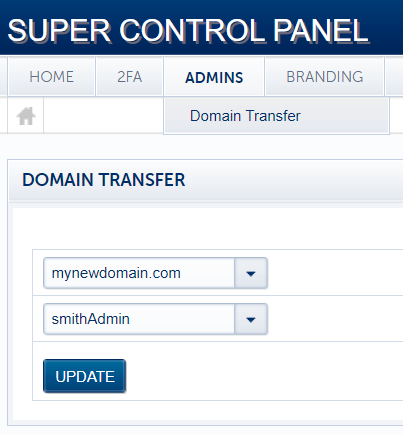
There are times when a customer may start under your direct management but later decides they want to manage their own settings, mailboxes, and quotas. Instead of deleting and recreating everything, you can simply transfer the domain from your Admin account to theirs.
When to Use This Feature
-
Customer Autonomy: A client wants to manage their own mailbox creation and resource allocation.
-
Account Reorganization: You are moving a specific domain to a new sub-admin for better organization.
-
White-Label Handoff: You’ve finished the initial setup for a client and are now handing over the "keys" to their own dashboard.
How to Move a Domain
The transfer is handled entirely within the Super Panel and takes effect immediately.
What Happens After the Transfer?
-
Instant Management: The new Admin will immediately see the domain in their own dashboard.
-
Mailbox Preservation: All existing mailboxes, aliases, and data associated with that domain remain intact and move with it.
-
Quota Allocation: The domain will now count against the destination Admin’s domain quota. Ensure the destination Admin has enough "Max Domains" allowed in their settings before you start.
Pro-Tip: Resource Check: Before moving a domain, use the pencil icon in the Admins list to verify that the destination account has enough available Mailbox and Storage quota to support the incoming domain's existing users.
Super Panel Settings
Update Your Super Panel Recovery Email
Your recovery email is essential for maintaining access to your Super Panel account if you ever forget your password. You can update this address at any time from within your Super Panel dashboard.
Ensure Continuous Access: Verify that you have a recovery email address on file and that you maintain consistent, long-term access to it. Remember to keep the subscription for your recovery email active and ensure any associated domain names are renewed on time.
Steps to change your recovery email
-
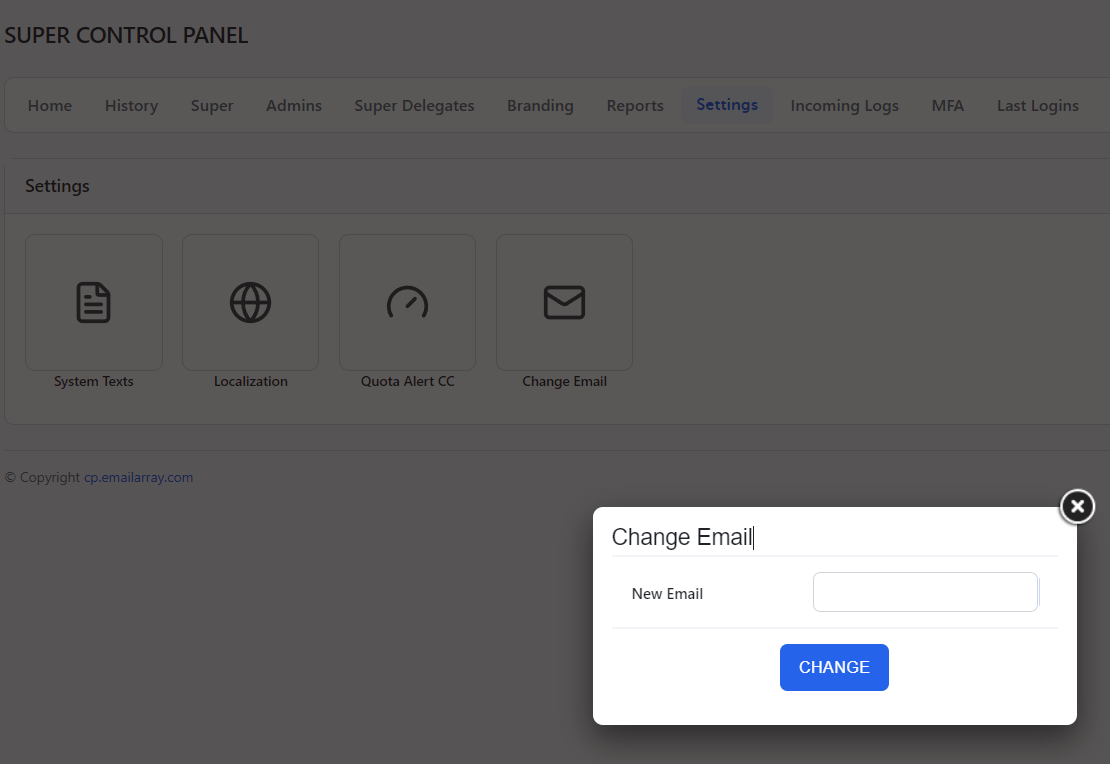
Access Settings: From the Super Panel, in the main navigation menu, click on the Settings tab.
-
Open the email update tool: Locate the Change Email icon and click on it.
-
Enter your new address: In the Change Email pop-up window, type your preferred email into the New Email field.
-
Save your changes: Click the blue CHANGE button to update your account settings.

Super Panel Branding for Webmail
As a Super, you have the ability to customize the visual identity of the Webmail interface for your network.
Setting your branding at the Super Panel level establishes a default theme that automatically applies to all of your Admin accounts and their associated domains.
These branding settings apply exclusively to the Webmail. They do not change the appearance of the Super Panel or the Admin Panel.
How to Update Your Network Branding
-
Log in to your Super Panel.
-
Click on Branding in the top menu bar.
-
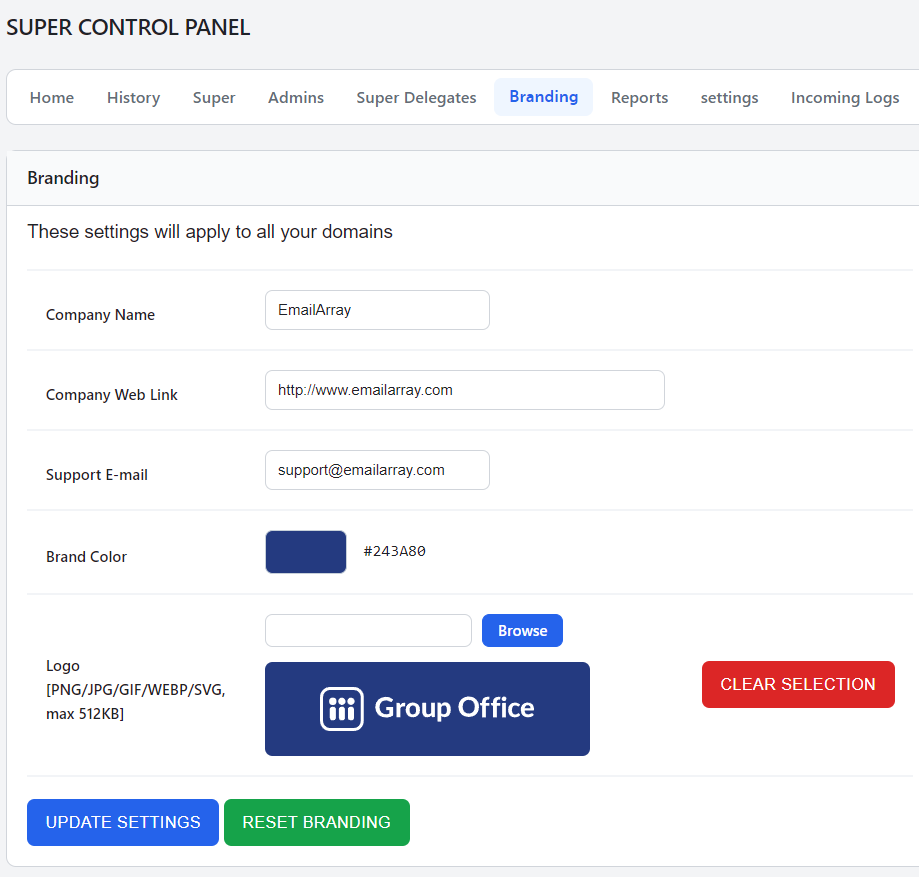
Update the customization fields as needed:
-
Company Name: Enter your business name. This will be displayed as the Webmail page title in the browser.
-
Company Web Link: Enter the link to your primary website.
-
Support E-mail: Enter the email address used as the sender for support or spam reports.
-
Brand Color: Choose your primary brand color or enter a specific hex code (e.g., #243A80) to customize the Webmail interface.
-
Logo: Click Browse to upload your logo file (supported formats: PNG, JPG, GIF, WEBP, SVG; max size: 512KB). Use the Clear Selection button if you need to remove a previously uploaded image.
-
-
Click the Update Settings button to save your changes.
Admin Permissions and Resetting
You retain full control over whether your Admins can override your default branding. When creating a new Admin or editing an existing one in the Super Panel, you can toggle the "Can set branding" option.
-
If set to "Yes": The Admin gains the ability to define a global branding configuration for all of their domains, as well as apply unique branding at the individual domain level. If the Admin clicks "Reset Branding", their configuration will revert to the standard GroupOffice branding.
-
If set to "No": The Admin is restricted from configuring both global and domain-level branding. Their users will strictly see the branding dictated by the system hierarchy.
Branding Priority Hierarchy
When an Admin has the permission to set branding, the system determines which settings to display based on a strict order of priority. The Webmail interface will check for custom settings in the following order and apply the first one it finds:
-
Domain-Level Branding: Custom settings applied to a specific domain.
-
Admin-Level Branding: Global settings applied by the Admin for all of their domains.
-
Super Panel Branding: The default settings you establish in the Super Panel.
-
System Default: The base GroupOffice branding.
Super Delegates
A Super Delegate is a specialized account that allows you to delegate administrative tasks while maintaining high security for your primary credentials. You can define granular access levels across different sections of the Super Panel, ranging from view-only to full permissions.
Super Delegate Scope Limit: Super Delegates cannot be restricted to manage only specific domains; they have access to the entire account infrastructure.
Common Use Cases
-
Team Collaboration: Assign individual accounts to team members to track actions and limit responsibilities without exposing your primary Super account.
-
Activity Tracking: Monitor the specific actions performed by individual delegates to maintain a clear audit trail of administrative changes.
Best Practices
Internal Team Members Sharing a single Super account is a significant security risk. Instead, create a unique Super Delegate for each team member to ensure accountability and safety:
-
Enable 2FA: Each team member should activate their own two-factor authentication for account security.
-
Tiered Permissions: Assign only the level of access required for their specific role to adhere to the principle of least privilege.
Manage Super Delegates
Add a Super Delegate
-
Go to the Super Panel.
-
Log in using your main Super username and password.
-
Click on Super Delegates in the menu.
-
Click on the New button.
-
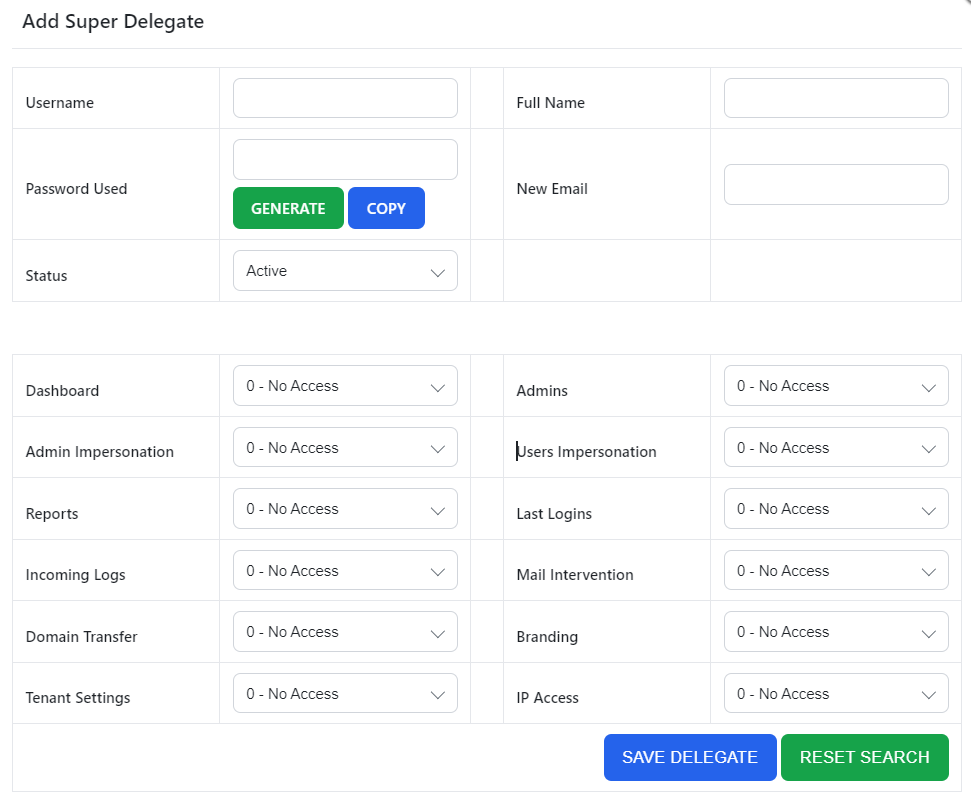
Fill in the details for your new Super Delegate:
-
Username: The desired login name for the delegate.
-
Full Name: The name of the team member.
-
Password Used: Type a secure password, or click GENERATE and then COPY to securely capture an auto-generated password.
-
New Email: The email address that will be used for password recovery.
-
Status: Select Active or Inactive from the dropdown.
-
-
Select the permissions for each section. Options range from "0 - No Access" upwards. You can configure access for the following areas:
-
Dashboard
-
Admin Impersonation
-
Reports
-
Incoming Logs
-
Domain Transfer
-
Tenant Settings
-
Admins
-
Users Impersonation
-
Last Logins
-
Mail Intervention
-
Branding
-
IP Access
-
-
Click the SAVE DELEGATE button to apply your changes.
Remove a Super Delegate
-
Go to the Super Panel.
-
Log in using your main Super username and password.
-
Click on Super Delegates in the menu.
-
Click on the Delete icon next to the Super Delegate you want to remove.
Update a Super Delegate You can update all details and permissions of an existing Super Delegate at any time.
-
Go to the Super Panel.
-
Log in using your main Super username and password.
-
Click on Super Delegates in the menu.
-
Click on the Edit (pencil) button next to the Super Delegate you want to update.
-
Update the necessary details. Leave the Password Used field blank if you want to update permissions but do not want to change their current password.
-
Click the SAVE DELEGATE button to save the changes.
Security Settings
Two-Factor Authentication for Super Delegates Log in as the Super Delegate and follow the standard instructions for enabling two-factor authentication to secure the account.