Document Editing
Editing Word Documents
OfficeDocs includes a full-featured word processor for creating and editing text documents. This guide provides an overview of the main editing tools and document features available in the editor.
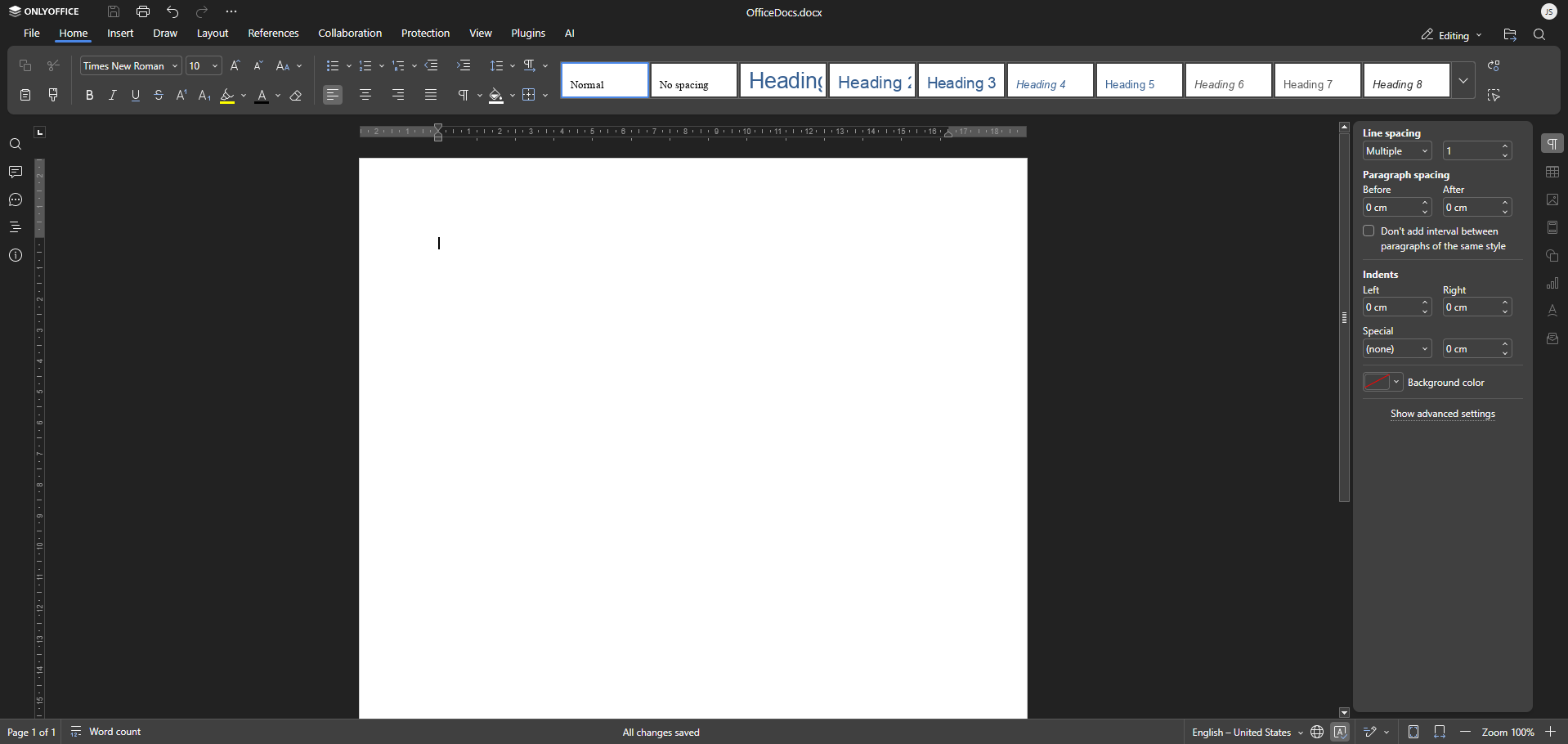
Document editor overview
When you open a Word document, the editor includes:
- Toolbar: Formatting and editing tools at the top of the page
- Document area: The main workspace where you write and edit content
- Status bar: Page count, word count, and zoom controls
- Sidebar panels: Additional tools for navigation, styles, and comments
Basic editing
You can perform common editing actions directly in the document.
Typing and editing text
- Click anywhere in the document to place the cursor.
- Type to insert text at the cursor position.
- Use Backspace to remove characters before the cursor.
- Use Delete to remove characters after the cursor.
Selecting text
- Click and drag to select text.
- Double-click to select a word.
- Triple-click to select a paragraph.
- Press Ctrl+A to select all content.
Formatting text
The toolbar gives you quick access to common formatting options, including:
- Font family and size
- Bold, italic, underline, and strikethrough
- Text color and highlighting
- Text alignment
- Line spacing
- Bulleted and numbered lists
- Indentation
Working with document structure
Use document structure tools to organize content more clearly.
Headings
- Apply Heading 1, Heading 2, or other heading styles from the style list.
- Use headings to create a clear document outline.
- Headings can also be used to generate a table of contents.
Sections
- Insert section breaks from the Layout menu.
- Use sections to apply different headers, footers, or margins in different parts of the document.
Inserting content
- Images
- Tables
- Charts
- Shapes
- Hyperlinks
- Page breaks
- Headers and footers
- Page numbers
- A table of contents
- Etc.
Page setup
Page layout options are available from the Layout menu, including:
- Margins
- Orientation
- Paper size
- Columns
Review tools
OfficeDocs includes review features to help you check and collaborate on documents.
- Spell Check: Identify and correct spelling errors
- Comments: Add notes without editing the main content
- Track Changes: Record edits for review
Saving your work
Changes are saved automatically as you work. You can also press Ctrl+S to save manually. Each save may create a version history entry.
Editing Spreadsheets
OfficeDocs includes a spreadsheet editor for working with Excel files and other spreadsheet formats. This guide introduces the main tools and features available when editing spreadsheets.
Spreadsheet editor overview
When you open a spreadsheet, the editor includes:
- Toolbar: Formatting, formulas, and data tools
- Formula bar: Displays and edits the contents of the selected cell
- Column and row headers: Help identify cell locations
- Cell grid: The main area for entering and editing data
- Sheet tabs: Switch between worksheets
- Status bar: Displays quick calculations and zoom controls
Working with cells
You can perform common actions directly in the spreadsheet.
Selecting cells
- Click a cell to select it.
- Click and drag to select a range.
- Click a column header to select an entire column.
- Click a row header to select an entire row.
- Press Ctrl+A to select all cells.
Entering and editing data
- Select a cell and start typing to enter data.
- Press Enter to confirm and move down.
- Press Tab to confirm and move right.
- Press Esc to cancel editing.
- Double-click a cell or press F2 to edit existing content.
- Use the Formula bar to edit longer values or formulas.
Working with formulas
Formulas in OfficeDocs begin with the = sign.
Examples:
-
=A1+B1 to add two cells
-
=SUM(A1:A10) to total a range
-
=AVERAGE(B1:B20) to calculate an average
-
=IF(A1>10,"Yes","No") to apply conditional logic
For more advanced usage, refer to the Working with Formulas guide.
Formatting cells
OfficeDocs provides a range of formatting options, including:
- Number formats such as currency, percentage, and dates
- Font size, font color, and cell fill color
- Borders and alignment
- Text wrapping
- Merging cells
Managing rows, columns, and sheets
You can adjust the structure of a spreadsheet as needed.
- Insert or delete rows and columns
- Resize rows and columns by dragging borders
- Hide or unhide rows and columns
- Rename, add, or remove sheets
- Reference cells from other sheets in formulas
Data tools
OfficeDocs includes tools to help organize and analyze spreadsheet data.
- Sort: Reorder data by column values
- Filter: Show only rows that match selected criteria
- Pivot Tables: Summarize larger datasets
- Charts: Present data visually
Saving your work
Changes are saved automatically as you work. You can also press Ctrl+S to save manually. Spreadsheets can be downloaded in supported formats such as .xlsx, .ods, .csv, or .pdf.